
Newsletter Subscribe
Enter your email address below and subscribe to our newsletter
Enter your email address below and subscribe to our newsletter


 ByJohn A
Everyone treats AOD-9604 and tesamorelin like fraternal twins because they both sit somewhere on the growth-hormone family tree. Everyone is wrong, and the record settles it in about two sentences.
In its pivotal Phase III trial, tesamorelin cut visceral adipose tissue by 15.2% while the placebo group’s visceral fat actually grew by 5.0%, in 412 patients, a statistically significant split [T1]. AOD-9604’s pivotal human trial, run on 536 subjects, failed to produce statistically significant weight loss, and the company developing it shut the program down [P4]. One compound cleared the bar regulators set. The other didn’t clear it and got walked away from. I’d love to tell you the rest of this comparison is complicated. It mostly isn’t.
The instinct, and I get it, is to treat “growth-hormone peptide” as one category and then sort by which one sounds gentler, or has the friendlier safety writeup, or the more elegant backstory. That instinct is exactly backwards. It ranks compounds by vibe and demotes the one number that was actually designed to answer the question: did it work in a controlled trial. Judge these two by vibe and AOD-9604 might even win, it’s a small, targeted fragment with a clean tolerability record. Judge them by the only test that matters and there’s no contest at all.
| Dimension | AOD-9604 | Tesamorelin |
|---|---|---|
| FDA approval | Not approved; development terminated 2007 [P4] | FDA-approved (HIV-associated lipodystrophy / excess visceral abdominal fat) [T1] |
| Pivotal human result | Failed to show significant weight loss, 24-week trial, 536 subjects [P4] | Visceral fat down 15.2% vs +5.0% placebo, 412 patients, significant [T1] |
| Best efficacy signal | Early 12-week study, ~2.6 kg vs 0.8 kg placebo, never confirmed at scale [P4] | Confirmed visceral-fat reduction in a powered Phase III trial [T1] |
| Studied population / endpoint | Obese adults; general weight loss (not met) [P4] | Adults with HIV and excess visceral fat; visceral adipose tissue (met) [T1] |
| Mechanism | 16-amino-acid GH fragment (C-terminal 176-191), meant to drive fat breakdown [P6] | GHRH analog that raises the body’s own GH and IGF-1; IGF-I up 81.0% in trial [T1] |
| Studied route | Oral, in the human trials [P5] | Subcutaneous injection [T1] |
| Human safety dataset | “Indistinguishable from placebo,” ~900 adults, 6 RCTs, no drug-related serious AEs [P5] | Established within its approved indication via Phase III trials and labeling [T1] |
| Honest read | Tolerable, but efficacy unproven | Approved, with a real endpoint in a real indication |
Two rows carry the whole verdict, and they’re the top two. Everything below them is commentary.
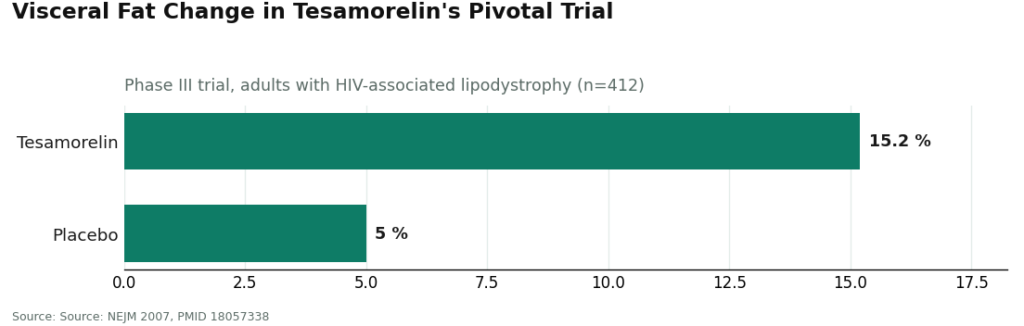
Here’s where I’ll push back on how these figures usually get placed side by side. Tesamorelin’s 15.2% visceral-fat drop against a 5.0% placebo increase came out of a randomized, placebo-controlled Phase III trial of 412 patients and hit statistical significance [T1]. That trial also logged an 81.0% rise in IGF-I, which lines up with the mechanism, the compound nudges the body’s own GH axis upward [T1]. That’s a number that survived scrutiny.
AOD-9604’s favorite number, the early 12-week result of roughly 2.6 kg versus 0.8 kg for placebo, gets quoted like it’s playing in the same league [P4]. It isn’t. It was a preliminary signal, and the whole point of running a bigger, 24-week, 536-subject trial was to confirm it. It didn’t confirm. The program got terminated in 2007 [P4]. Stacking an unconfirmed early number against a confirmed pivotal one and calling it a fair fight is the exact mistake the failed trial exists to correct.
I don’t get to just win this argument and walk off. AOD-9604 has one row that’s genuinely good, and pretending otherwise would be its own kind of spin.
The safety data is real. Pooled across roughly 900 adults in six randomized, placebo-controlled studies, AOD-9604 came back “indistinguishable from placebo,” no drug-related serious adverse events, no drug-related withdrawals [P5]. That’s a solid, reasonably sized safety record, and I’m not going to wave it away.
But here’s the concession that doesn’t actually rescue the compound: safety measures cost, not benefit. A peptide that’s extremely well tolerated and doesn’t move the needle isn’t a good bet, it’s a low-risk way to spend money on nothing. The entire justification for accepting any risk is a payoff, and for AOD-9604 in humans, the pivotal trial didn’t deliver one. Good tolerability is a real point on the ledger. It just isn’t the point that decides anything.
If your situation is the one tesamorelin was approved for, excess visceral abdominal fat with HIV-associated lipodystrophy, this isn’t close. Tesamorelin has the trial and the approval [T1]. That’s a defined indication with data that maps directly onto it, and it’s worth being precise that use outside that population is a different clinical conversation entirely.
If your goal is general weight loss with no underlying condition, my contrarian instinct wants there to be a clean answer, and there isn’t one. Neither peptide has a strong, confirmed case for that goal, and AOD-9604’s case is worse than neutral, general weight loss is literally the endpoint its 536-subject trial tested and missed [P4]. So the honest reframe isn’t “pick your peptide.” It’s: one compound is proven for a narrow medical indication, and the other was tested for the broader goal you actually care about and came up empty.
The mechanism story doesn’t rescue AOD-9604 either, however much I’d like a tidier ending. Tesamorelin works upstream, prompting the body to release more of its own growth hormone, visible in that 81.0% IGF-I bump [T1]. AOD-9604 was engineered as an isolated fragment meant to hit fat breakdown directly [P6]. A cleaner mechanism on a whiteboard doesn’t outrank a missed clinical endpoint in the real world. That’s the whole argument, condensed.
There’s a factor sitting outside the trial numbers that still matters: who’s overseeing the thing, because that changes real-world risk no matter what the efficacy column says.
Tesamorelin is an approved medication and gets handled that way. AOD-9604, without approval, mostly shows up online as a research chemical, unverified contents, no clinician, no follow-up, which is about the riskiest way to get an injectable into your body. The better path, for anyone who still wants to pursue AOD-9604 despite the weak evidence, keeps a licensed provider in the loop. In the supervised telehealth model FormBlends operates, a physician reviews the case first, weighs the (thin) upside against the failed pivotal trial before anything is prescribed, and routes any compounding through a licensed pharmacy. I want to be clear about what that oversight does and doesn’t do: it changes how the peptide is handled. It does not change whether it works. The data gap between these two compounds is exactly as wide with a doctor in the room as without one.
Score it honestly and this isn’t a rivalry, it’s a mismatch. Tesamorelin carries an FDA approval and a confirmed Phase III result, 15.2% visceral-fat reduction against a 5.0% placebo increase in 412 patients, within its indication [T1]. AOD-9604 carries a genuinely good safety record and a failed pivotal trial, no significant weight loss across 536 subjects, program terminated [P4][P5]. For tesamorelin’s approved use, tesamorelin is the evidenced pick. For general weight loss, neither peptide is proven, and AOD-9604 specifically failed the trial that was supposed to prove it. Sharing a growth-hormone label makes these two sound like cousins. The scorecard says one of them passed the test that counts and the other didn’t, and no amount of clean mechanism, good tolerability, or supervised access closes that gap.
Which one actually reduces visceral fat, AOD-9604 or tesamorelin? Tesamorelin, and it isn’t close. It has a confirmed 15.2% visceral-fat reduction against a 5.0% placebo increase in a 412-patient Phase III trial [T1]. AOD-9604 has no positive visceral-fat result at all, its biggest trial measured general weight loss and missed [P4].
If tesamorelin’s 15.2% and AOD-9604’s 2.6 kg are both real numbers, why treat them so differently? Because one survived a confirmation trial and the other didn’t get the chance to. The 15.2% came from a powered, placebo-controlled Phase III study that hit statistical significance [T1]. The 2.6 kg was an early signal that a larger, 536-subject, 24-week trial was specifically built to confirm, and it failed to [P4]. Confirmed and unconfirmed aren’t the same scale.
AOD-9604 sounds pretty safe. Why did the program get killed? Safety and efficacy are separate scoreboards. AOD-9604’s pooled data across roughly 900 adults in six randomized trials looked “indistinguishable from placebo,” with no drug-related serious adverse events [P5]. But the program still ended in 2007 because the pivotal trial didn’t produce significant weight loss [P4]. Tolerable and effective are two different questions, and AOD-9604 only answered one of them.
Is AOD-9604 FDA-approved for weight loss? No. Its weight-loss development was terminated, and it’s since been positioned more as a food-ingredient classification than a medication [P4][P6]. Tesamorelin is FDA-approved, but strictly for reducing excess visceral abdominal fat in adults with HIV-associated lipodystrophy [T1].
Since both touch growth hormone, can they be swapped for each other? No, they act at different points on the axis. Tesamorelin is a releasing-hormone analog that raises the body’s own GH and IGF-1, IGF-I rose 81.0% in trial [T1]. AOD-9604 is an isolated fragment meant to act on fat breakdown more directly [P6]. The shared label obscures that one cleared its pivotal trial and one didn’t.
What’s the least reckless way to get AOD-9604 given how thin the evidence is? The recklessness is usually in the sourcing, research-chemical vendors online sell it with no quality verification and no clinician involved. Keeping a licensed provider on file, the setup FormBlends operates in, adds physician review, a prescription only when warranted, and pharmacy compounding [P5]. It’s a better way to handle the peptide. It doesn’t make the efficacy case any stronger.
T1. Tesamorelin pivotal Phase III trial: visceral adipose tissue decreased 15.2% with tesamorelin versus a 5.0% increase with placebo, and IGF-I increased 81.0%, in 412 patients with HIV and abdominal fat accumulation. Metabolic effects of a growth hormone-releasing factor in patients with HIV. New England Journal of Medicine, 2007. https://pubmed.ncbi.nlm.nih.gov/18057338/ P4. Independent obesity-pharmacology review: AOD-9604 12-week trial showed ~2.6 kg vs 0.8 kg placebo, but development was terminated in 2007 after the drug failed to induce significant weight loss in a 24-week trial of 536 subjects. Obesity Pharmacotherapy: Current Perspectives and Future Directions, Current Cardiology Reviews, 2013. https://pmc.ncbi.nlm.nih.gov/articles/PMC3584306/ P5. Human safety pooled across ~900 adults in six randomized, placebo-controlled studies: AOD9604 tolerability “indistinguishable from placebo,” no drug-related serious adverse events. Safety and Tolerability of the Hexadecapeptide AOD9604 in Humans, Journal of Endocrinology and Metabolism, 2013. P6. AOD9604 described as a nutraceutical ingredient (a 16-amino-acid C-terminal fragment of growth hormone) with GRAS status for foods, drinks and dietary supplements, a food-ingredient classification rather than a drug approval. Safety and Metabolism of AOD9604, Journal of Endocrinology and Metabolism, 2014.
AOD-9604 is not an FDA-approved drug, and the largest human weight-loss trial run on it did not beat placebo. Tesamorelin is FDA-approved, but for a specific indication, and any mention of its trial data here describes that studied population, not a general weight-loss claim.
AOD-9604 is a lab-made fragment of human growth hormone, specifically the tail segment (roughly amino acids 176-191), isolated because early research pointed to that region driving fat metabolism without the growth-promoting side of the full molecule. Unlike full HGH, it doesn’t appear to meaningfully raise IGF-1, which is exactly why it got pitched as a fat-loss compound rather than a muscle-building one.
The evidence is thin, and I’d rather say that plainly than dress it up. Animal studies looked promising, but the human trials run by Metabolic Pharmaceuticals in the early 2000s didn’t produce statistically significant fat loss, which is the main reason it never reached approval. There are anecdotal reports floating around the internet, but anecdotes aren’t a substitute for a controlled trial. Anyone telling you it definitely works in humans is speaking with more confidence than the published record earns.
Depends heavily on where you are and how you’re getting it. In the US, AOD-9604 isn’t FDA-approved for anything, so marketing it as a drug or a supplement isn’t allowed. Some compounding pharmacies have prepared it under physician supervision, though the FDA has kept a close eye on that practice. Research-chemical sites will sell it to anyone, no quality guarantees, no regulatory accountability attached. If a prescriber decides it’s appropriate for a given case, the lower-risk legal route runs through a licensed compounding pharmacy operating under physician oversight, such as FormBlends.
The trials reported a fairly mild profile, injection-site reactions were the most common gripe, with occasional headache and nausea. Because the fragment doesn’t seem to push IGF-1 the way full HGH does, worries like insulin resistance or acromegaly-type effects look less likely, but “less likely” isn’t the same as “proven safe.” There’s no long-term human safety data to lean on, so caution isn’t optional here, it’s the only responsible stance.
Written by Jae Bianchi, health editor. Checking each figure against the cited source. Last reviewed January 2026.
For education, not prescription. Consult a healthcare professional before you begin anything new.
